Wi-Fi 7 vs Wi-Fi 6: Which Is Better For Your Business Network in 2025?
- Martin Honoret
- Oct 28, 2025
- 5 min read

As we advance through 2025, businesses are increasingly relying on robust wireless connectivity to support remote work, cloud applications, and emerging technologies. The decision between Wi-Fi 7 and Wi-Fi 6 represents a critical infrastructure choice that will impact your organization's performance, productivity, and competitive edge for years to come.
Understanding the technical differences and practical implications of each standard is essential for making an informed investment decision. While Wi-Fi 7 offers impressive theoretical capabilities, Wi-Fi 6 remains a proven, cost-effective solution for many business environments. We'll examine both standards to help you determine which aligns with your organization's specific requirements and growth objectives.
Understanding Wi-Fi 7: The Next Generation Standard
Wi-Fi 7, formally known as IEEE 802.11be, represents a significant advancement in wireless technology. This latest standard delivers theoretical maximum speeds of up to 46 Gbps: approximately 4.8 times faster than Wi-Fi 6's peak performance of 9.6 Gbps. In practical applications, businesses can expect speed improvements of approximately 2.4 times faster performance compared to equivalent Wi-Fi 6 configurations.
The most revolutionary feature of Wi-Fi 7 is Multi-Link Operation (MLO), which fundamentally changes how devices connect to networks. Unlike previous standards that restrict devices to a single frequency band, MLO enables simultaneous connections across 2.4 GHz, 5 GHz, and 6 GHz bands. This capability dramatically increases throughput while reducing latency, making it particularly valuable for real-time applications such as video conferencing, VoIP communications, and cloud-based collaboration tools.

Wi-Fi 7 also incorporates several advanced technical improvements that enhance overall network performance. The standard supports 320 MHz channel bandwidth in the 6 GHz spectrum: double that of Wi-Fi 6: enabling significantly faster data transfers. Additionally, Wi-Fi 7 implements 4096 QAM (Quadrature Amplitude Modulation), providing 20% higher transmission rates, and supports up to 16 spatial streams compared to Wi-Fi 6's eight streams.
Another notable innovation is Preamble Puncturing, which allows the network to work around interference without dropping entire channels. This feature is particularly beneficial in dense urban environments where spectrum congestion is common, ensuring more consistent performance for business-critical applications.
Wi-Fi 6: The Established Enterprise Standard
Wi-Fi 6 (IEEE 802.11ax) has proven itself as a reliable, mature standard that addresses many of the connectivity challenges faced by modern businesses. The technology incorporates Orthogonal Frequency Division Multiple Access (OFDMA) and Multi-User Multiple Input, Multiple Output (MU-MIMO) technologies, which significantly improve network efficiency by allowing multiple devices to communicate simultaneously without creating congestion.
The primary advantage of Wi-Fi 6 lies in its widespread device compatibility and proven track record. Most current business equipment, including laptops, smartphones, tablets, and IoT devices, already support Wi-Fi 6, eliminating the need for extensive hardware replacement during implementation. This compatibility ensures immediate performance benefits without the complexity and cost associated with comprehensive infrastructure overhauls.
Wi-Fi 6E represents an enhanced version of the standard, providing access to the less congested 6 GHz spectrum. This additional bandwidth can deliver substantial performance improvements in environments with high device density or spectrum interference, offering a middle-ground solution between Wi-Fi 6 and Wi-Fi 7.
From a cost perspective, Wi-Fi 6 equipment has reached market maturity, resulting in competitive pricing across routers, access points, and client devices. For small to medium-sized businesses with standard connectivity requirements, Wi-Fi 6 provides an optimal balance of performance improvement and budget efficiency.
Technical Performance Comparison
When evaluating these standards for business deployment, several key performance metrics differentiate Wi-Fi 7 from Wi-Fi 6. Maximum theoretical throughput represents the most significant difference, with Wi-Fi 7's 46 Gbps potential far exceeding Wi-Fi 6's 9.6 Gbps ceiling. However, real-world performance depends heavily on specific hardware implementations, environmental factors, and client device capabilities.
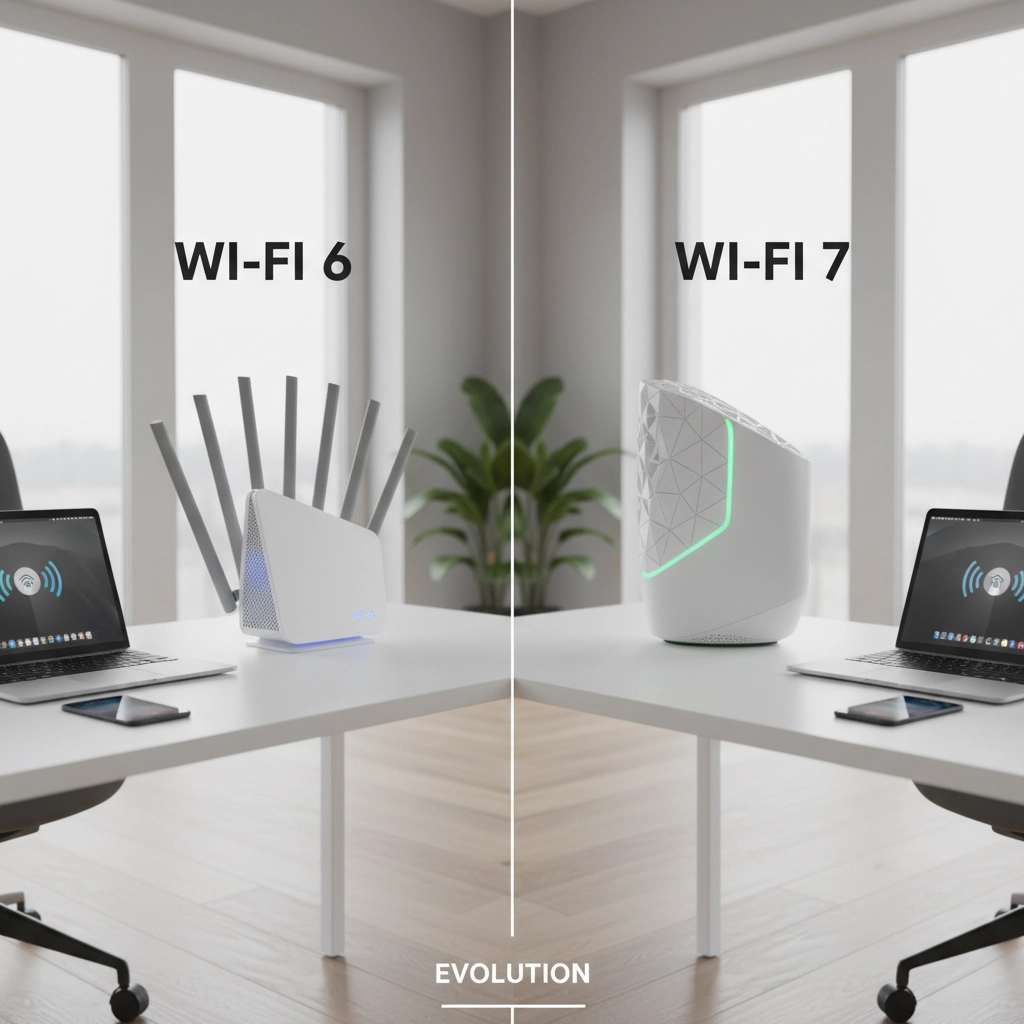
Latency reduction stands as another critical differentiator. Wi-Fi 7's MLO capability and advanced signal processing techniques result in significantly lower latency compared to Wi-Fi 6, particularly beneficial for applications requiring real-time responsiveness such as video conferencing, VoIP systems, and cloud-based business applications.
Network capacity and device handling capabilities also vary substantially between the standards. Wi-Fi 7's increased spatial streams and advanced modulation techniques enable superior performance in high-density environments, making it ideal for large office buildings, conference facilities, or manufacturing environments with extensive IoT deployments.
However, it's important to note that laboratory specifications don't always translate directly to practical performance improvements. Independent testing has revealed that some high-quality Wi-Fi 6 and Wi-Fi 6E routers actually outperform certain Wi-Fi 7 implementations, particularly models lacking full 6 GHz support or 320 MHz channel width capabilities. This variability underscores the importance of evaluating specific hardware rather than relying solely on standard specifications.
Business Implementation Considerations
The decision between Wi-Fi 7 and Wi-Fi 6 extends beyond technical specifications to encompass practical business considerations. Infrastructure compatibility represents a significant factor, as Wi-Fi 7 deployment typically requires replacing routers, access points, and potentially client devices to fully realize the standard's benefits. This comprehensive upgrade can represent substantial capital expenditure that may not provide immediate returns for all organizations.
Device ecosystem readiness differs markedly between the standards. Wi-Fi 6 devices are readily available across all categories, from enterprise-grade access points to smartphones and IoT sensors. Wi-Fi 7 adoption remains in the early stages, with limited device availability and premium pricing for early implementations.

Implementation timeline considerations also play a crucial role in decision-making. Organizations requiring immediate network improvements can deploy Wi-Fi 6 solutions without delays, while Wi-Fi 7 implementations may require waiting for broader device availability and price stabilization.
For businesses planning long-term technology investments, Wi-Fi 7 represents a future-proof solution that will support emerging applications and increased bandwidth demands. However, organizations with immediate connectivity needs may find Wi-Fi 6 provides sufficient performance while offering better value and faster deployment.
Industry-Specific Applications and Use Cases
Different business sectors benefit uniquely from each standard's capabilities. Professional services firms, financial institutions, and healthcare organizations with standard office applications, email systems, and conventional video conferencing needs often find Wi-Fi 6 provides adequate performance with proven reliability and cost-effectiveness.
Manufacturing environments, large retail operations, and entertainment venues with high device density and demanding real-time applications stand to benefit significantly from Wi-Fi 7's advanced capabilities. The standard's superior handling of multiple simultaneous connections and reduced latency make it particularly valuable for AR/VR applications, IoT deployments, and mission-critical real-time systems.
Educational institutions and co-working spaces face unique challenges with high user density and diverse device types. Wi-Fi 7's MLO capability and improved spectrum efficiency can provide substantial benefits in these environments, though the implementation cost must be balanced against budget constraints typical in these sectors.
Strategic Recommendations for Business Networks
Organizations should upgrade to Wi-Fi 7 when operating in high-density environments experiencing network congestion, planning deployment of AR/VR applications, AI systems, or extensive IoT networks, requiring minimal latency for mission-critical real-time applications, or making long-term technology investments with 3-5+ year horizons.
Wi-Fi 6 remains the optimal choice for small to medium enterprises with standard connectivity requirements, organizations needing cost-effective performance improvements without total infrastructure replacement, businesses requiring immediate deployment capabilities, or companies supporting primarily traditional office applications and standard video conferencing.

For organizations seeking professional guidance in wireless infrastructure planning and implementation, partnering with experienced IT consultants can ensure optimal technology selection and deployment strategies. Professional assessment of your specific network requirements, device inventory, and growth projections enables informed decision-making that balances performance needs with budget realities.
The wireless networking landscape continues evolving rapidly, and the choice between Wi-Fi 7 and Wi-Fi 6 depends on your organization's unique circumstances, performance requirements, and strategic objectives. By carefully evaluating these factors against each standard's capabilities and limitations, businesses can make infrastructure investments that support current operations while positioning for future growth and technological advancement.
Whether pursuing immediate connectivity improvements through Wi-Fi 6 implementation or investing in Wi-Fi 7's advanced capabilities for future-ready networking, the key lies in aligning technology decisions with business objectives and operational requirements.
Comments